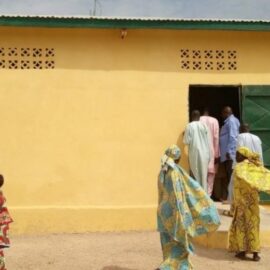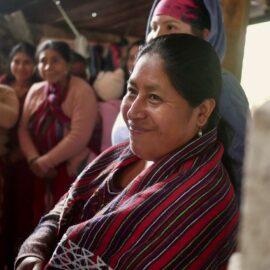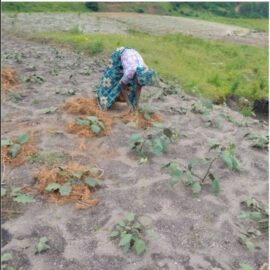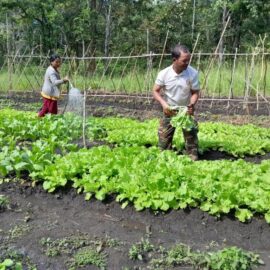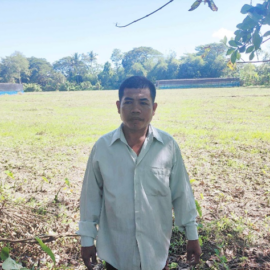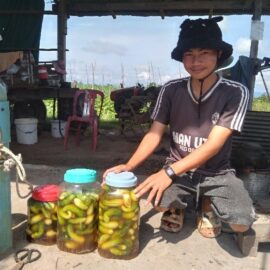
Angola…now that is a country you don’t hear too much about. Part of what I love about FRB is our member’s willingness to work in difficult contexts, in places many of us have to look up on a map to truly know where it is. Honestly, I have yet to meet anyone that has Angola on their top ten list of places to visit before they die. That could be because most of the people I know don’t speak Portuguese, the national language of Angola, or perhaps because it was recently in the throes of a long civil war.
I watched a program this week that reminded me of the power of food. The program is a travel show that documents the trip of a British chef, Jamie Oliver, who explores the US by seeking out the food and tastes of the local areas he visits. This particular episode took him to the Navajo reservation in Arizona. The community has been struggling to find a way to combat a high rate of obesity and diabetes, especially amongst the younger members of their community. One way that they have been trying to combat these trends is to try and encourage the younger generation to once again become familiar with the traditional recipes. This program only gave a quick glimpse into this world, but it showed that as the community came together over the planting of crops and the preparation of the traditional foods the community was becoming aware of ways to be healthier and was keeping alive cultural traditions that were generations old.
A couple of years back, FRB had guests from our development programs traveling with staff and host families here in the US. We were having farmers and staff members of our in-country partners in the US for 10 days to visit a few of our community projects and participate in two significant events in the state of Iowa, the Iowa Hunger Summit and the World Food Prize.
My wife hosted a woman farmer from Guatemala and the director of our partner there. She took them to some of the farmers around Rock Valley, IA in the project there so they might see harvesting, Iowa style. At one of the farms, as so often happens, the woman was given opportunity to drive the combine harvesting corn. She was so excited to be able to have the experience of driving a combine. She said, "I have never driven anything in my life! I have never even driven a car, but now I have driven a combine!" Later, I saw a post on face book from her companion from; "Aquí estoy manejando una "combi" o combinada en Iowa. como decía un amigo en guatemala, esto es grande!!! Who needs to translate that, you just know what he is saying.
Meanwhile, I traveled in Minnesota with a Hmong farmer from Laos and a staff member of our partner there. We had similar experiences with similar excitement. There are places where they live that are not even able to be reached by car, and here they were, driving tractors and combines and soaking in all the newness of their first time visits and first time airplane rides.
After nearly a week, FRB staff brought our visitors to Des Moines for the Hunger Summit and Food Prize. The 12 guests from 7 countries met each other and were able to share all their experiences and excitement and it was great fun to watch their faces as they shared their stories. However, when asked if they would share the most surprising or impressive thing they saw during their weekend visit........... no one listed the experience of driving a combine. We FRB staff were struck how each one of our visitors mentioned the feeling they had of being welcomed, being cared about, and impressed how willing these farmers and communities were to share with people they had never met.
Tuesday was the Iowa Hunger Summit and some of these same farmers were presenters in an afternoon session. To listen to the farmers, one man and 3 women, tell of their overcoming the hardships and obstacles in their countries was an incredibly humbling experience. Here they were in a strange country, in a room filled with strangers, sharing the powerful story of how life in their villages was now better because of the wonderful things they had accomplished after being given the opportunity and dignity of improving their own lives.
I can not fully describe how I felt to hear them tell their story, but it was very touching to me as I reflected on it. They looked out at their audience with clear and honest eyes that shown with passion. They sat nervous yet shared their stories unafraid...........with dignity.
Posted by By Ron De Weerd, Director of Resource Development
It was 4 a.m. on a springlike day in February and I was in a taxi on my way to the airport, bound for one of my trips overseas. Following our exchange of “Good Mornings” and his confirmation that my destination was the airport, it was too dark to see the face of my driver as I sleepily wondered about his accent.
We rode in silence for several minutes before he spoke. “You have very heavy bags. Are you going to Africa?”
“No, but I have been there.”
He straightened slightly and asked, “Have you been to Ethiopia?” When he learned that I had been to his home city, he spoke fondly about his visits there, then voiced his concerns about the challenges of living in the U.S., which he'd faced for nearly two decades.
One of the challenges was evident when I apologized for only having a $100 bill to pay my fare. He hesitated a moment and then reached under the floor mat to find the needed change. He commented, “It’s just like Africa here. You need to protect your money or you lose it in this job.”
I thanked him and headed into the airport. I prayed for him and was reminded of the many other wonderful people who have blessed me with taxi rides to and from the airport over the years.
There was the teacher from Eritrea who had come to study in a major city but whose stipend only covered the rent. With a family to feed, he quit school and moved to a good-paying manufacturing job in a smaller city. When the company downsized he had little seniority, lost his job, and ended up driving a cab.
He spoke with such pride of his daughter, now making top grades in medical school. “I could not afford to send her to a private school. You know what the public schools are like here, so I tutored her and her brothers every night.” His eyes moistened as he added,“They hated every minute of it, but now my daughter thanks me. I will do whatever job it takes to help my children have a chance in life. I am living my life through them.”
Then there was the graying father from Nigeria who was supporting his boys through college, as well as a “lost boy” from Sudan. Having come to work directly from a church service, he was dressed in a suit and tie. He told me of his gratitude for life, a job, and his church community.
I ponder all of this as I sit in an airport after missing a flight on my way to a country where many have an unrealistic image of the “American Dream.” I think not only of the taxi drivers I have met, but also the migrant workers who live and work so hard in my community and countless others across the country. It is their remittances to families in their home countries that are the largest sources of income there. A deep sense of dignity and pride prevents them from sharing the hard realities of their current lives with their families.
What is my role in sharing the truth as I arrive with my heavy bags, to be joined by special people from Foods Resource Bank growing project? These volunteers are coming not to do something they have decided is good for the people we will meet, but to work with them side by side.
May our listening ears and sweat equity support communities and individuals in their aspirations to feed their families with dignity over the long term! May both hosts and guests be wise and courageous in learning and sharing the truth in love!
By Bev Abma, Executive Director of Overseas Programming
About six weeks ago I had the opportunity to attend a Christian Community Development Association Institute. One of the presenters handed us a poem that resonated with me and I would like to share it for this week's blog. As a staff member of an organization that focuses on world hunger I usually center around the stories of development, so this poem of U.S. poverty is a bit different slant for me, but when you reach the last paragraph you will read the very words that have become a primary theme or maxim at the Foods Resource Bank.
My name is not "Those People". I am a loving woman, a mother in pain, giving birth to the future, where my babies have the same chance to thrive as anyone.
My name is not "Inadequate." I did not make my husband leave us.....he chose to, and chooses not to pay child support. Truth is though; there isn't a job base for all fathers to support their families. While society turns its head, my children pay the price.
My name is not "Problem and Case to Be Managed." I'm a capable human being and citizen, not just a client. The social service system can never replace the compassion and concern of loving grandparents, aunts, uncles, fathers, cousins, community.....all the bonded people who need to be but are not present to bring little ones forward to their potential.
My name is not "Lazy, Dependent Welfare Mother." If the unwaged work of parenting, homemaking, and community building were factored into the gross domestic product, my work would have untold value. And why is it that mothers whose husbands support them to stay home and raise children are glorified? And why don't they get called lazy or dependent?
My name is not "Ignorant, Dumb, or Uneducated." I got my PhDo from the university of life, school of hard everything. I live with an income of $621 with $169 in food stamps for three kids. Rent is $585....that leaves $36 a month to live on. I am such a genius at surviving, I could balance the state budget in an hour. Never mind that there's a lack of living-wage jobs. Never mind that it's impossible to be the sole emotional, social, spiritual, and economic support for a family. Never mind that parents are losing their children to gangs, drugs, stealing, prostitution, the poverty industry, social workers, kidnapping, the streets, the predator. Forget about putting more money into our schools......just build more prisons!
My name is not "Lay Down and Die Quietly." My love is powerful, and the urge to keep my children alive will never stop. All children need homes and people who love them. All children need safety and the chance to be the people they were born to be.
The wind will stop before I allow my sons to become a statistic. Before you give in to the urge to blame me, the blame that lets us go blind and unknowing into the isolation that disconnects your humanity from mine, take another look. Don't go away. FOR I AM NOT THE PROBLEM, BUT THE SOLUTION. And..................
my name is not "Those People."
By Julia K. Dinsmore
from her book, "My Name is Child of God.........not 'those people'
Blog by Ron De Weerd, FRB Director of Resource Development
In the Mambere-Kadei area of the Central African Republic, not only do people raise crops, some tribes also herd cattle. The Fulani people are renowned for their love of cattle and as a people group, they span multiple borders from CAR north to the Sahel desert. Peter and I were privileged to visit several groups of Fulani cattle today and were able to speak with two Fulani men about their cattle practices versus those of Peter and his dad in the US. Peter, a cattle man at heart, looked absolutely at home amongst the long-horned Zebu. I, on the other hand, timidly walked amongst them with a rather apprehensive look on my face. Keeping up with Fulani herdsmen is no small task. These men travel 20 miles a day or more moving their cattle from place to place. Each cow has a name and can be recognized on site by its owner. After several hours of tromping through grasslands trying to get close to the skittish cows, we returned back to the CEFA office to wish our hosts well. Their parting words were that they were happy to show us the cattle, to walk together, Christians and Muslims, as a sign of peace, understanding and brotherhood. They look forward to future collaboration with the CEFA program and above all else, understanding between the different cultures here in Gamboula.
We started our trip with several flights, finally landing in Cameroon. After a short sleep we piled into a truck with four others and began a day-long journey driving East across Cameroon. At 4pm we were safely at the border after eating our fill of omelettes later in the day. Once we got over the border and through all of the passport formalities, we made our way to the Eglise Evangelique Baptiste (EEB) mission station. The station was developed by Swedish missionaries decades ago, and thanks to them there exists a 120 bed hospital, housing, a nurses training school, bible school and elementary school.
Our host for our 10 days here is Benoit Zangao, director of CEFA, and the CEFA staff. We ate dinner with Benoit at his home the night of our arrival. We were served chicken and while we ate we were given the explanation for the value of chicken in the local culture. When someone prepares a chicken for you, it has more value than if you had slaughtered a cow, goat, pig, sheep or any other animal. Chickens are served to those you want to show great honor, respect or celebration. Thus, our visit was honored with a chicken. We were the ones feeling extremely honored to have eaten with Benoit and his family. What, I wondered, do I do to show honor to guests in my home?
The CEFA staff and local farmers have been very keen to hear about Peter’s farm (he grows soy, corn and beef cattle with his dad, and sells crop insurance). Equally so, Peter has been intrigued to learn about farming in CAR and the use of crops for human food that in the US we primarily use as animal feed. While visiting the hospital nutrition center yesterday, we showed him a sack of corn and soy blended flour. This flour mix, along with added micronutrients and vitamins, is sometimes provided to the hospital and malnourished patients courtesy of the World Food Program. Many of the sacs come from US corn and soy donations. Peter admitted to never having eaten the corn and soy that he grows. On hearing this, Clarisse, the director of the hospitals nutrition center, hatched a plan for Peter to join the mothers and children in preparing and eating the high protein porridge. Today, Peter, at 6’3”, sat amongst the children eating the very porridge that will bring life back to their bodies. At the same time, we talked about the importance of having a garden of your own. The mothers of the children in the nutrition center will work and learn in the hospital nutrition garden, just one of the programs under CEFA’s umbrella. Peter says, “it was definitely one of those out of body experiences.” It put a whole new perspective on growing corn and soy.
A trip of a lifetime lay ahead of me. I was going half way around the world to Laos and Thailand, to a world I knew little about. For weeks prior to my departure, I busied myself preparing for this adventure; studying about the countries, getting my immunizations. Anxiety and excitement surged over me all at the same time. Packing became a major ordeal. After all, I take 3 weeks to pack for a long week end and THIS was 3 weeks halfway around the world! I’ll take my grey slacks (they won’t show the dirt); I’ll pack my black slacks too (they’ll show even less dirt). Don’t forget my Khakis (for dress-up), throw in a skirt or two, some hiking shoes, some walking shoes, and oh, don’t forget the sandals. Find a place to shove in the hand sanitizer, a head lamp (for those nighttime treks to the latrine…I think that’s just an “uppity” word for outhouse), some sunscreen, insect repellent, a trekking pole, some Kleenex and baby wipes (I’d heard stories about those “no toilet tissue” places, and I figured, if these work for babies, they would be just fine for me). Don’t forget the long undies for the cold nights in the mountain villages, and the short undies for the hot humid days in town. Remember to pack the allergy pills, the Tylenol, the cold tablets, the Band-Aids, the lip balm, the Dramamine, the sinus tablets and anything else a good pharmacy could put in a suitcase.
Part of Foods Resource Bank’s strategic plan is to involve young people in the growth and development of its programs. This is the perfect time of year to go to the FRB website at www.foodsresourcebank.org to see how you can help support FRB in a variety of ways, in a number of different countries.
It was so exciting to hear of the travels of Nicholas Kuperus and Abby Genzink to Africa on an FRB program visit this summer, but prior to their departure a part of me thought, why weren’t their seats made available to other “more experienced/mature” individuals who could appreciate this opportunity more? How could the world of Xbox, Wii, Facebook and Twitter be set aside long enough to make this trip meaningful?
Nicholas and Abby’s presentation was quick to set me straight. Both delivered a recount of their experiences with confidence and reassurance, and yes, even with some introspection. Nicholas recalled, “…the minute I stepped out of that plane, I was stepping away from everything I knew about life. Seeing the shacks made from Coca Cola and Pepsi signs and scrap sheet metal was something that I will never forget. To see so many people with hardly anything, yet happy, was a good reminder of how we, even with all our stuff, can still be unhappy.”
Abby shared with me, “This trip challenged my worldview and the way I think about myself and about God. We were able to immerse ourselves into a whole different culture. We tried new (sometimes yucky!) foods, heard many different languages, and went on an incredible safari. More than anything, being in Africa made me ask questions I had never thought about before. Specifically, why did God put me in Byron Center, Michigan? Being in Africa gave me a deep feeling of purpose and belonging, and coming back to the States was harder than I ever dreamed it would be. I wondered why God had put some of His children in the misery of poverty and some in a land of freedom and opportunity. I never came up with a good answer, but I was convinced that since God has deliberately given me an abundance of blessings, there is no other option but to serve Him with the things He has given me. I was made very aware that everything I do is an opportunity to glorify Christ. Being in Africa gave me more of a desire to honor God in the time I have been given on this Earth. My trip to Africa has given me a new vision. Although I cannot fully explain how, I see life differently. The things God taught me while I was there have dictated the decisions I make and the way I react to things. The trip to Africa instilled in me an interest in the political and economic issues happening in Africa now and a passion for missions I didn’t know I had. I still have experiences that make me think of my time in Africa and I know that it will play a part in my future and even the career I choose. I am so grateful to have had this experience and I thank God for the blessing it was to have gone!”
Having listened to Nicholas and Abby I was reminded that God chose a young inexperienced boy to become a king of a nation, a young boy with only a basket of bread and a few fish to feed thousands, and a young fourteen or fifteen year old girl to become the mother of His Son. Their open minds and unblinded eyes allowed them to accept the possibilities that God had planned for them while yet unhampered by the anxieties of the “experienced/mature” individuals who are quick to say, “I can’t do that…I can’t go there.” I have a lot to learn from young people.
May this not only be a “lasting memory” for Nicholas and Abby, but a lasting reminder to me that opportunity is never wasted on the young. Will you pray with me that the Lord will show His purposeful plan to the youth of our nation as well as the youth of Africa?
by Judy Dayton,
Byron Center MI growing project
When you work for FRB, you talk to the most interesting people from the most fascinating growing projects! I just got off the phone with Burt Keefer from the Pigeon MI growing project in Michigan’s “thumb.” (For those who don’t understand the reference, just look at any map of MI – or the U.S. – to see our state’s mitten shape and our famous thumb.)
The Pigeon growing project is unique in that, in addition to soy and corn, they grow white winter wheat, edible beans like navy beans (for your pork ‘n’ beans!), “black turtle soup” beans (for your black beans and rice), and sugar beets. Michigan’s thumb area is a large producer of sugar beets for the refined sugar industry. Thinking of garden beets, I asked Burt, “What do they do with all the red?” Well, there isn’t any red in sugar beets! They kind of look like huge turnips, pale and elongated, not round like a red beet.
Recent comments
4 weeks 1 day ago
14 weeks 2 days ago